The playbook for this country is not written yet. I only publish what I have verified.
Tap below to vote for it. The countries with the most votes get written first.
I lost $300K, then the $60K I took to Cebu. I'm rebuilding. Here's every mistake, so you don't repeat them.
If you saw the reel, this is the real spreadsheet and the real list of what went wrong. Free. The tools are optional.
By Galaxy (Tony Long II), living in Cebu since September 2024
Educational only, not financial, legal or tax advice. Costs, rates and visa rules change. Verify before you act.
$3,375
Estimated monthly cost there
$700
about 42,700 pesos
You keep each month
$2,675
Saved and invested for 20 years at 7%
$1.39M
Cost uses the midpoint of the Cebu City range ($500 to $900). It leaves out visas, flights and taxes. Your numbers will differ.
What happened to me
I lost $300,000 in crypto. That is not a typo and it is not a flex.
In September 2024 I moved to the Philippines with about $60,000 left. Over the next two years, that money was gone too.
I am not writing this from the other side of a comeback. I am rebuilding right now, in public, and I do not have a tidy ending for you yet. I currently spend about $743 a month in Cebu. That number is real. The rest of the story, where the $60,000 went, is not something I have decided how to talk about, so I am not going to guess at it here.
This playbook exists because of what I got wrong, not what I got right. Every number, mistake and fix on this page is here so you do not repeat what cost me.
These are real mistakes. Some I made personally. All of them cost money, time, or both. Filter by topic and open any one.
#1Using a foreign debit card at ATMs
Most PH banks charge $5 per withdrawal for foreign cards.
Fix: Use a local partner's card: 18p fee versus $5. GCash cash-out at sari-sari stores is often cheaper (about 50p per 1,000p).
#2Keeping T-Mobile active after you arrive
At $155 a month that bill is almost as much as rent in Cebu. Roaming burns money fast, and Verizon and AT&T barely work in the Philippines anyway.
Fix: Upgrade to an international plan for your layover only, then cancel when you land. A Smart SIM is about 299p for data.
#3Not having $2,000 liquid on arrival
The first apartment requires 2 months deposit plus 1 month advance. If you are tight, you cannot secure housing.
Fix: Have cash accessible. Not in crypto. Not in stocks. Liquid cash.
#4Converting money at the airport
Airport exchange rates run 10 to 15% worse than market.
Fix: Use GCash, Wise or an ATM. Never the airport counter for large amounts.
#5Not opening GCash immediately
GCash is the financial infrastructure of everyday Philippines.
Fix: Get a Smart SIM on day one. Open GCash on day two.
#6Not notifying your US bank and cards before traveling
Banks flag foreign transactions and freeze cards. You can be left with zero access to your funds.
Fix: Call every card issuer before you fly and add a travel notice. Do it for all cards, not just one.
#7Hotel-hopping instead of booking a base
Hotels are expensive per night, wifi is inconsistent and you waste hours moving.
Fix: Book a 30-day Airbnb before you land, around $500 a month, for a stable base.
#8Not checking for flooding
Some apartments flood every rainy season and the landlord will not mention it.
Fix: Ask neighbors directly. Check Google Maps satellite view for low areas. Avoid Lapu-Lapu unless in a highrise.
#9Not checking internet speed before signing
Some areas have weak infrastructure, and a bad connection kills remote income.
Fix: Run a speed test at the unit during the day and ask which provider the neighbors use.
#10Ignoring the electric bill history
AC is expensive in the Philippines. One unit runs around 4,000p a month, and the bill can spike with reconnection fees if power gets cut.
Fix: Ask for the last 3 months of bills and budget for AC realistically.
#11Not negotiating rent
Posted prices are negotiable, especially for longer stays.
Fix: Offer 10 to 15% less. Commit to 6 months and use that as leverage.
#12Forgetting to factor in pet costs
Landlords charge significantly more for pets or refuse them entirely.
Fix: Be upfront about pets in the search and add the premium to your budget.
#13Missing your visa renewal window
Overstaying is illegal and costs more every day. It incurs 500p per month of overstay plus escalating immigration fees, and you cannot leave the country until you settle.
Fix: Set a calendar reminder 3 weeks before expiry. Never let it get close.
#14Not getting your ACR I-Card early
Without it you renew your visa every 1 to 2 months. The card is forced on you after 59 days anyway and costs an extra $40 to $50 at renewal.
Fix: Apply as soon as you have a permanent address. It unlocks 6-month renewals.
#15Paying forced expedited fees
Immigration offices now charge for expedited processing by default, even if you did not select it.
Fix: Budget 2,000p extra per renewal as a buffer, and renew well before expiry to push back.
#16Eating at Western restaurants every meal
In the first week, Western food can run $30 to $50 a day.
Fix: Find your nearest palengke (wet market) in week one. Rice, protein and vegetables cost about 150p per person per day.
#17Taking unmetered taxis
Yellow cabs are metered and fine for short trips. Black van taxis cost more for no reason. With any taxi, if you leave something inside you will not get it back.
Fix: Use Grab for most trips. Grab does not work in Davao, so use taxis there.
#18Buying a motorbike before knowing the roads
Philippine traffic is chaotic, and going straight to ownership before you understand it is a risk.
Fix: Rent for 2 to 3 weeks first. Buy when you understand how traffic flows in your area.
#19Not learning basic Bisaya phrases
Cebu is not Manila. English is less common, especially outside IT Park.
Fix: Learn: Pila? (how much), Salamat (thank you), Dili (no), Oo (yes). It changes every interaction.
#20Not having a VPN
Many US companies block Philippine IPs and treat you like a hacker. Streaming, some banking portals and work tools can all be blocked.
Fix: Get ExpressVPN or NordVPN before you land. Some sites blacklist your IP permanently without one.
#21Not mapping your work hours before you arrive
Cebu is UTC+8 and US clients are UTC-5 to UTC-8. You need a clear schedule before you land.
Fix: Decide your core overlap hours and build your Cebu life around them.
#22Relying on one income source
Remote income fluctuates. One lean month in the Philippines is recoverable. Ongoing is stressful.
Fix: Start building a second stream before you leave the US.
#23Bringing too much luggage
You can buy almost everything cheaper here.
#24Skipping travel insurance in the first month
Philippine hospitals require cash upfront. SafetyWing covers this cheaply.
#25Trusting random taxi drivers for apartment referrals
They get commissions. Find listings yourself on Facebook Marketplace.
#26Not registering with the US Embassy STEP program
Enrollment is free. In emergencies the embassy can find you.
A water filter or refill station costs 5 to 10p per container.
#29Not preparing for brownouts
Power outages happen, especially in wet season. Get a UPS for your router.
#30Signing up for slow internet
Converge is generally faster than PLDT for the price in Cebu.
#31Sending money via Western Union
GCash, Wise or a wire are cheaper for regular transfers.
#32Not having a backup power bank
Heat plus constant use drains batteries fast here. Power banks are cheap.
#33Expecting US customer service timelines
Service culture is warm but timelines are different. Build patience in.
#34Overlooking mall pharmacies
Many medications are dramatically cheaper and available without a prescription.
#35Not building suki relationships at the market
Regular customer status gets you better prices over time. Show up consistently.
#36Forgetting rainy season planning
June to November is wet season. Flooding can disrupt travel and affect housing areas.
#37Not budgeting a flight home per year
Cebu to the US is $600 to $1,200. Budget one round trip annually.
#38Not backing up documents digitally
Keep digital copies of your passport, visa stamps and ACR card in Google Drive, plus physical copies at home.
#39Assuming credit cards work everywhere
Many small businesses are cash-only. Always carry 1,000 to 2,000p cash.
#40Neglecting your US credit score
Keep one US card active with a small monthly charge.
#41Not building a local expat network
Other expats have already solved most of your problems. Find the Facebook groups.
#42Skipping the barangay certificate
It is required for many processes. Get it early as proof of local residency.
#43Over-relying on Airbnb for long stays
Airbnb 30-day rates run 30 to 40% higher than direct Facebook Marketplace rentals.
#44Not understanding palengke pricing
Wet market prices are not fixed. Everything is negotiable, especially at the end of the day.
#45Forgetting timezone math with US family
8pm in Cebu is 7am in Phoenix. Schedule calls or you will miss everyone.
#46Not telling your bank about international travel
Cards get frozen for foreign activity if you did not add a travel notice.
#47Waiting too long to research US expat taxes
Look up the FEIE (Foreign Earned Income Exclusion). It may reduce your US tax liability significantly. Confirm with a qualified tax professional.
Chapter 2
The arbitrage math: why this works
Geographic arbitrage is not complicated. You earn money in a strong currency and spend it in a weak one. The gap between the two is yours to keep.
In the United States a $5,000 per month remote income is decent but not free. After rent, car, food, insurance and the constant nickel-and-diming of American life, you are left with maybe $500 in savings if you are disciplined. In the Philippines the same $5,000 stretches so far that the math feels like a cheat code.
₱56 to ₱61Pesos per dollar. It was 56 in Sept 2024 and about 61 in 2026. Check xe.com.
3 to 5xPurchasing power multiplier
$743My full monthly spend in Cebu
The core equation
Strong currency income (USD) divided by weak currency expenses (PHP) equals your arbitrage gap. That gap, invested monthly, is one way to build wealth on a normal income. I am still rebuilding mine.
The real comparison
Category
Scottsdale AZ
Cebu
Saved / month
Rent
$800
$276 (4BR house)
$524
Food
$800
$160 (family of 7)
$640
Car / transport
$460
$120 (motorbike)
$340
Car insurance
$160
$0
$160
Car maintenance
$300
$0
$300
Phone
$155
$28 (3 SIMs)
$127
Internet
$120
$27
$93
Utilities / electric
$110
$110
$0
Entertainment
$150
$50
$100
Total
$3,055
$771
$2,284
That is $2,284 saved every month by this category breakdown, a 75% cut in expenses. The fully itemized numbers in the next chapter land on a slightly different total ($3,375), since they break out a few extra categories this table groups together.
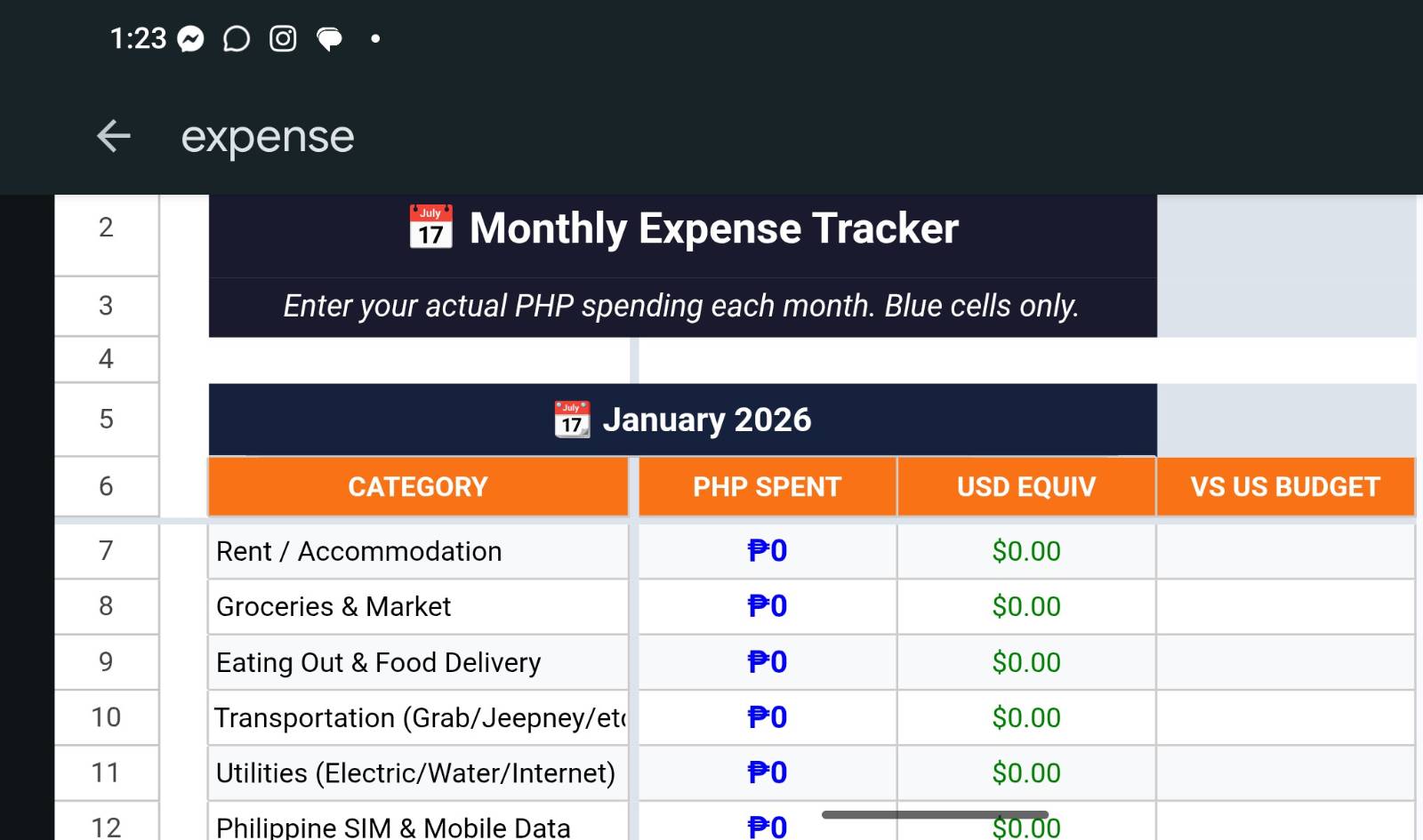
The calculator at the top uses city averages. The kit version runs your actual income, your costs and your timeline.
These are not hypothetical. I left Scottsdale in September 2024, and every number below is what I actually spent.
Scottsdale, AZ: what I was spending
Expense
Monthly
Rent (room in shared house, half of a $1,600 2BR)
$800
Car insurance (required in AZ)
$160
Car maintenance and repairs (monthly average)
$300
Gas (Phoenix sprawl means constant driving)
$150
Food and groceries (cooking plus eating out)
$800
Entertainment (bars, events, subscriptions)
$150
Internet (home)
$120
Car wash (desert dust is constant)
$30
Phone (T-Mobile)
$155
Credit card minimums (carrying balances)
$200
Sending money to PH (supporting family already there)
$400
Utilities / electric (AC in Arizona is not optional)
$110
Total
$3,375
Income at the time: $3,000 to $4,500 per month. The phone bill alone was almost as much as my Cebu rent.
Cebu, Philippines: what I spend now
I live on the mountain behind IT Park. It is a province area with mostly Bisaya-speaking neighbors and cheaper rent than central Cebu.
Expense
Pesos
USD
Notes
Rent (4BR house)
15,600p
$276
Includes 800p HOA
Electric bill
6,200p
$110
One AC unit alone is about 4,000p
Phone (3 SIMs)
1,600p
$28
Smart PH + Google Voice + eSIM US number
Internet
1,500p
$27
Home fiber
Food (family of 7)
9,000p
$160
Market shopping, home cooked
Motorbike payment
6,200p
$110
2025 Aerox, brand new, 200 miles on arrival
Gas (whole month)
1,100p
$20
Full tank lasts weeks
School supplies
500p
$9
Kids' needs
Total
41,700p
~$743
Full family covered
That is $2,632 a month less than Scottsdale, a 78% cut.
Chapter 4
Banking and money flow
I do not use a traditional expat banking setup. I run almost entirely on crypto with a few fiat bridges. This is my actual workflow.
Income arrives
USD lands by wire, Venmo, CashApp or Moneygram depending on the client. I receive into Chime: no fees, and it works well for remote workers.
Convert to crypto and self-custody
Transfer from Chime to Robinhood. Convert USD to Solana or Bitcoin. Send it to my Phantom wallet where I own my own private keys. I keep small amounts on Coinbase for daily spending. Solana clears in 2 seconds on the Coinbase card and I earn 1% back in Bitcoin on every purchase.
Philippines conversion
When I need pesos I convert crypto to PHP through GCash (my wife's account). I cash out at an ATM with her BDO card: an 18 peso fee versus $5 for foreign cards. At sari-sari stores a GCash transfer costs 20 to 50 pesos per 1,000, depending on the store.
Backup methods
Moneygram direct to BDO for larger transfers. A debit card for online purchases. Wire transfers when needed.
Get pesos before you land
Some US banks and currency exchange services let you order Philippine pesos in advance. The rates are not perfect, but cash on arrival removes day-one stress.
ATM fee reality
Foreign debit cards get hit with about a $5 fee per ATM withdrawal at most Philippine banks. A local partner's card drops that to 18 pesos (about $0.32). On 4 withdrawals a month that saves $19.68. Small, but it adds up.
Accounts I actually use
Platform
Purpose
Notes
Chime (US)
Primary USD receive
No fees, instant transfers
Robinhood
USD to crypto
Easy interface
Phantom Wallet
Self-custody storage
Own your keys, own your coins
Coinbase
Daily spending + debit card
1% Bitcoin back on purchases
GCash (PH)
Crypto to PHP cash-out
Wife's account
BDO Bank (PH)
PHP bank account
Joint with wife: wire receives, ATM
CashApp / Venmo
Receive from US clients
Common for freelance
Moneygram
Large USD to BDO transfers
Good rates for big amounts
Chapter 5
The move: how I did it
I left Scottsdale in September 2024. My daughter's birthday is in September and mine is in October. Those two dates were the deadline that made it real. I sold as much as I could, moved the rest into storage, and left.
12 months outDecision madeCommitted mentally and started tracking Philippine cost of living. This is when the arbitrage math first clicked.
6 months outLiquidation beginsSold everything with resale value: furniture, electronics, anything not going into storage. Every dollar funded the move.
3 months outStorage arrangedRented a storage unit for what could not be sold, and anything I might want eventually.
1 month outFlight bookedScottsdale to Tokyo Narita, a 6 hour layover, then Cebu. The Tokyo stop cost $160 in food, bus and airport navigation. Worth every peso.
Arrival, September 2024Landed in CebuMy third time in the Philippines, but staying long-term is a completely different experience than visiting.
Weeks 1 to 2Hotel bouncing (the mistake)Wifi quality varied wildly. Some spots killed my ability to work and some were near nothing useful. Do not do this.
Month 1Airbnb baseA 30-day Airbnb for around $500. Stable wifi, a kitchen, and time to search properly for an apartment. This should be step one, not step three.
Month 2Permanent homeSecured the current house: 4 bedrooms at 15,600 pesos per month ($276) including HOA, on the mountain behind IT Park.
Chapter 6
City breakdown: Cebu, Manila, Davao
The Philippines is not one cost of living. Where you land changes everything. Here is the breakdown of the three cities most expats consider.
Metro Manila
The capital. Most international, highest costs, best infrastructure and airport connections.
Rent
$400 to $800
Food
$200 to $350
Transport
$50 to $100
$800 to $1,400
Best for corporate remote workers and people who fly internationally often.
Cebu City / Metro Cebu
The second city. Best balance of cost and quality, a strong expat community, and IT Park is the digital hub.
Rent
$250 to $500
Food
$120 to $200
Transport
$30 to $80
$500 to $900
Best for remote workers, families and long-term expats. The sweet spot.
Davao City
Mindanao's cleanest city. Very affordable and growing fast, but Grab does not work here, so you use taxis.
Rent
$150 to $350
Food
$80 to $150
Transport
$20 to $50
$300 to $600
Best for budget-focused expats who want a quieter life.
Galaxy's pick: the mountain behind IT Park
I live in the province area behind IT Park, Cebu. It is a Bisaya-speaking community and cheaper than central Cebu: 15,600 pesos per month ($276) for a 4-bedroom house. You trade convenience for savings.
Chapter 7
The first 90 days: what to do and when
The first 90 days make or break the move. Most people waste the first month bouncing hotels, overpaying for everything and making expensive mistakes. Here is the optimized sequence. Tick items as you go. Your progress saves on this device.
0 of 25 done
Before you land
Week 1: arrive and stabilize
Weeks 2 to 4: find your home
Months 2 to 3: get legal and stable
Screenshot slot: Move Checklist
This checklist covers the first 90 days. The kit's version is built for any Southeast Asia country.
The Philippines has one of the most foreigner-friendly visa structures in Southeast Asia. Here is the real breakdown. Rules and fees change without notice, so confirm everything with the Bureau of Immigration (immigration.gov.ph).
What I am on now
Tourist visa extensions
US citizens get an initial 30-day stay on arrival. You extend at the Bureau of Immigration in 1-month, 2-month or 6-month increments, up to 36 months total. Each extension costs roughly 3,000 to 5,000 pesos.
Galaxy's take: The lowest barrier. Get in, get established, and figure out long-term status while you are here.
Get this early
ACR I-Card
Required once you have been in the Philippines more than 59 days. It costs about 5,000 pesos, adds $40 to $50 to your visa renewal fee, and unlocks 6-month renewals. Apply as soon as you have a permanent address.
Galaxy's take: The biggest quality-of-life upgrade for staying long-term. Do not wait.
Available to me, not yet obtained
13A spousal visa
For foreigners married to Filipino citizens. It grants indefinite residency, no more renewals and legal work rights, for roughly 10,000 to 15,000 pesos in fees and processing.
Galaxy's take: If you are married to a Filipino, this is your long-term play. I qualify now and it is on the roadmap.
For long-term capital holders
SRRV: Special Retiree Visa
Available at 35 and older with $20,000 to $50,000 deposited in a Philippine bank. Permanent residency while the deposit is maintained.
Galaxy's take: Not relevant for most remote income builders. More relevant if you are moving savings here long-term.
Verify every figure and requirement here directly with the Bureau of Immigration before acting on it.
Chapter 9
Remote income: keeping USD coming in
The arbitrage only works if the USD keeps coming in. Here is how to build and protect remote income from abroad.
Highest reliability
Service business
Sell a skill directly to US clients: copywriting, design, development, consulting, cold calling, lead gen. You own the client relationship and income is predictable.
Galaxy: GalaxyConverts does landing page audits and rebuilds for US local businesses at $500 to $1,500 per project. Cold calling is the acquisition method and no paid ads are needed to start.
Highest leverage
Newsletter and media
Build an owned audience and monetize it through digital products, affiliates and sponsorships. It scales without your time.
Galaxy: Galaxy Arbitrage Weekly is this play in real time. It takes time to build, and I am building it while rebuilding everything else.
Best passive income
Digital products
Build once, sell forever: calculators, templates, playbooks, guides. No fulfillment, and Stripe handles delivery.
Galaxy: This playbook is one. The Southeast Asia Arbitrage Kit is more of them. Every newsletter issue creates content that can become a product.
Revenue multiplier
Affiliate income
Refer people to services you already use, such as SafetyWing, Wise and Revolut, for 20 to 30% commission on recurring subscriptions.
Galaxy: Layer this on top of your content. Do not build a business on affiliate income alone. It is a multiplier, not a foundation.
Chapter 10
The action plan: your next 30 days
Reading this playbook is not the move. Executing is the move. Pick where you are right now.
0 of 7 done
Still in the US
0 of 7 done
Just arrived
0 of 6 done
Established abroad
Track every peso from day one and watch your arbitrage gap move, up or down.
This is the playbook I wish existed before I moved. I still lost the money. I am rebuilding, in public, one newsletter issue at a time. The tools in the kit are the ones I built for myself first.
Galaxy Arbitrage Weekly drops every Tuesday and Friday.
- Galaxy (Tony Long II), Cebu, Philippines
Tell me your situation
Reply to any Galaxy Arbitrage email with where you are right now (still in the US, just arrived, or established) and the one thing you are stuck on. I read every reply.